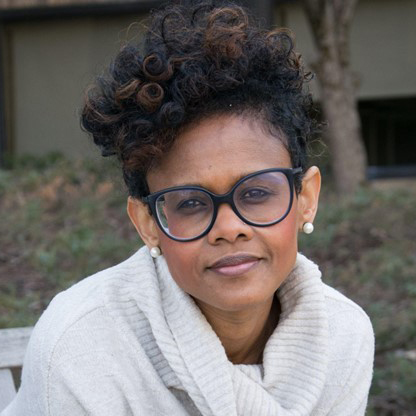

Kris Sealey’s areas of research are in Critical Philosophy of Race, Caribbean Philosophy, Decolonial Philosophy and 20th Century Continental Philosophy. Her published work investigates questions of belonging in the aftermath of the Middle Passage, community formation in the aftermath of conquest in the Americas, and resistive productions of home in the context of a post-colonial world. Dr. Sealey’s first book, Moments of Disruption: Levinas, Sartre, and the Question of Transcendence, was published in 2013 with SUNY Press. Her second book, Creolizing the Nation, published in 2020 with Northwestern University Press, was awarded the Guillén Batista book award by the Caribbean Philosophical Association in 2022. Dr. Sealey is the co-editor of two volumes, soon to be published with Roman & Littlefield: Creolizing Sartre, and Creolizing Critical Theory: New Voices in Caribbean Philosophy. She is currently working on two book projects. The first aims to develop a theory for creolized world-making practices that are both abolitionist and decolonial in their political orientations. The second is an investigation of everyday experiments with freedom at the level of Black cultural production, with particular emphasis on Black mothering and other-mothering.
Project Title: Variants in the Machine: Black Mothers Making Futures Against Natal Alienation
Abstract: What began as a supplication in the dark wake of Atlantic slavery about how, exactly, is one to sustain a vision of a future conducive to Black livingness throughout one’s care for Black children has developed into this monograph-length project driven by the question: How did Black mothers before me do this exact thing? What were the maps of their own place as Black mothers in the world, and who did they bring into their mothering practices toward imagining futures conducive to Black livingness and Black freedom? Like Alice Walker’s search for her Black mothers’ gardens, perhaps my search in Variants in the Machine will be for our Black mothers’ maps. Maps that aren’t quite to the Door of No Return that Dionne Brand writes about, but certainly maps that navigate the natal alienation and lineage theft initiated at that Door. Variants in the Machine: Black Mothers Making Futures Against Natal Alienation aims to recover a historical narrative of the relations and socialities Black mothers (enslaved, formerly enslaved and the descendent caretakers of Black life) built as they strung together maps for stealing back the futurity stolen by natal alienation (the violation at the core of commodifying Black bodies during Plantation slavery).
Within the fields of Black Studies and the Critical Philosophy of Race, scholars often return to the ‘person-to-chattel’ transformation of Plantation slavery to make sense of what came to be, by the late seventeenth century, the foundational categories of race and racialization in the modern world. Much of this scholarship is premised on the claim that the landscape of our contemporary post-modern moment is shaped by chattel slavery’s afterlife, that we continue to operate in what Christina Sharpe aptly names slavery’s “wake”. Resource distribution, predisposition to premature/untimely death and precarity under the state are all inflected (or often outright determined) by this wake. Black mothering practices unfold against (and despite) this wake. It is the enduring mark of Europe, the Caribbean and North America, regions that, via their mutual entanglement in a history of Plantation economy and racialized capitalism, mark the time of Blackness as it stands between the “no longer enslaved” and “not yet free” (Saidiya Hartman’s final sentence in Scenes of Subjection).
Hartman’s demarcation – the “no longer enslaved but not yet free” - orients my search for a Black mothering map against the violations of natal alienation? Variants in the Machine aims to adequately theorize what is in-between the “no longer” and the “not yet”, which I argue is a story of Black life on the move, away from chattel, and toward some elsewhere. What lies in-between Hartman’s “no longer” and “not yet” are Black world-making, audacious imaginings and praxes that are all manner of refusal, oppositional and resistive. It is a rich space, this in-between, alive and dynamic precisely in Black life’s insistence on staying on the move. My position at the outset of Variants in the Machine is that Black mothering maps are integral to that full story, and I bring these maps to Critical Black Studies for the robust attention they deserve.